• home
  • vocab
  • tutoring
  • blog
  • help

Make Your Point > Archived Issues > PREVARICATE

Send Make Your Point issues straight to your inbox.


pronounce PREVARICATE:

pruh VAIR uh kate
Your browser does not support the audio element.


connect this word to others:

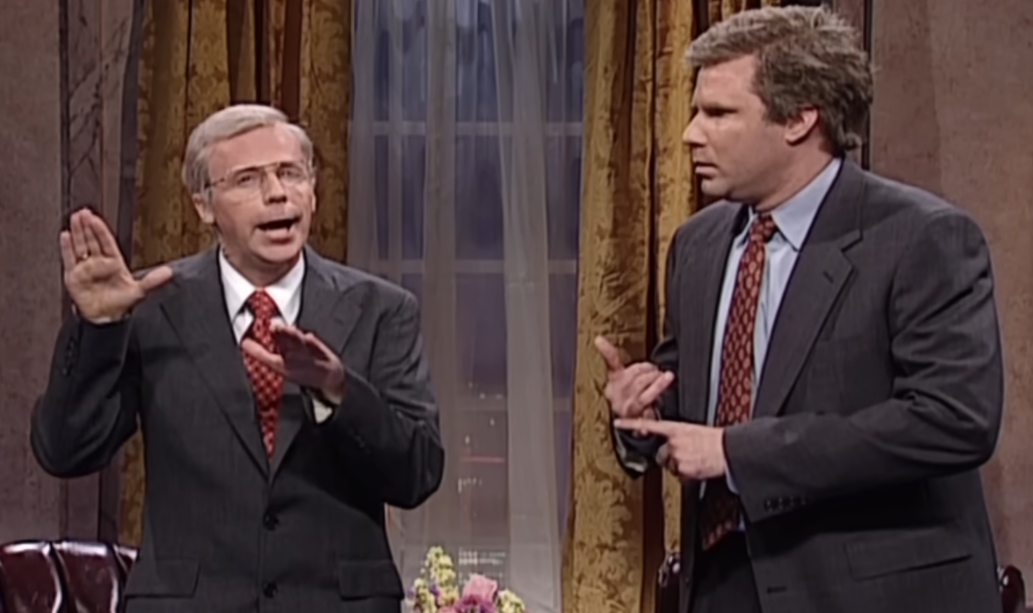
In a "Father & Son Bush" SNL skit from 2000, Bush Junior learns how to prevaricate from his father:

(Source)

Bush Junior: Here's the crap they're always askin' me. Should we use the budget surplus to pay off the national debt?

Bush Senior: Maybe.

Junior: Is Microsoft a monopoly?

Senior: Possibly. Could be! Kinda!

Junior: How about the environment?

Senior: Good!

Junior: Good?

Senior: Just good.

Junior: What about social security?

Senior: Should be very social... and very secure.

I referenced this same hilarious scene back when we studied the word c_g__, meaning "unwilling to say much, as if careful to guard your own secrets." Can you recall that one?

As Bush Senior demonstrated, to prevaricate is to hedge, to dodge, to sidestep, to evade, to eq__v_cate ("to speak in an unclear way in order to hide what you really mean"). To be slip-slidin' away from pointed questions—and from the truth.

(To reveal any word with blanks, give it a click.)  

definition:

"Prevaricate" traces back to a Latin word that most literally meant "to straddle before," and was used to mean "to walk crookedly," or more abstractly, "to step out of line: to behave incorrectly, to break the law."

As far back as the 1500s, we've used "prevaricate" in English to mean "to disobey a law, or go against one's faith." We'd talk about people prevaricating the law, or prevaricating their faith; soon, the meaning loosened up: we'd talk about people prevaricating the truth, meaning, turning aside from it.

That sense of turning away from the truth is how we use "prevaricate" today:

To prevaricate is to talk or act in a way that sneaks away from the truth, instead of just stating the truth (and instead of outright lying).

And, to prevaricate is to avoid making a statement or a decision, instead of just speaking honestly or taking action straightforwardly.

grammatical bits:

Part of speech:

Verb, usually the intransitive kind: "If you ask her about policy, all she does is prevaricate."

Other forms: 

The other verb forms are "prevaricated" and "prevaricating."

The noun is "prevarication," and it's the uncountable kind: "We're tired of all the prevarication."

how to use it:

Pick the slightly rare, slightly judgmental, scholarly-sounding word "prevaricate" when you want to sound serious as you describe someone weaseling away from the truth. It's a great word to pick whenever when the phrase "beat around the bush" sounds too folksy, and yet you still want to express frustration with someone who ought to state the facts or take action but won't.

Talk about people prevaricating, often on certain issues, or in response to certain questions or situations.

Or, say that someone doesn't prevaricate when you want to emphasize the clarity and directness of their comments, especially when the subject matter is painful or awkward.

examples:

"One president of a prestigious university has had to resign; two others remain on hot seats. The reason? They could not straight out say that someone advocating genocide against Jews on their campuses would be violating university codes of conduct... So, why did the three college presidents prevaricate when asked how they would respond to such language?"
  — David Horsey, Seattle Times, 14 December 2023

"Asked by [the documentarian Griffin Dunne] why she wrote about thoughts of divorcing her husband in an essay later reprinted in 'The White Album,' [Joan Didion] does not prevaricate. 'You used your material, you wrote what you had,' she says. “'That was what I had at the moment.'"
  — Kenneth Turan, The Guardian, 26 October 2017

has this page helped you understand "prevaricate"?


Awesome, I'm glad it helped!

Thanks for letting me know!
If you have any questions about this term, please message me at Liesl@HiloTutor.com.


study it:

Explain the meaning of "prevaricate" without saying "mince words" or "talk ambiguously."

try it out:

Richard Stengel seems to argue in favor of prevarication:

"Humankind cannot bear 'nothing but the truth.' Meursault in Camus's The Stranger is incapable of lying and is executed for it. Prince Mishkin in Dostoevsky's The Idiot is a man of perfect honesty who brings disaster to everyone he meets. And in Liar, Liar, Jim Carrey, who has played a few idiots in his time, is even more insufferable as a truth teller than as an inveterate b.s. artist."

Does he have a point? Considering that his examples come from fiction and film, do you think his point holds up in real life: that is, do we actually prefer it when people prevaricate?


before you review, play:

Try to spend 20 seconds or more on the game below. Don’t skip straight to the review—first, let your working memory empty out.

Our game this month is Subject Line Matching!

Try matching each capitalized term below with the email subject line that I used to introduce it. For an extra challenge, try recalling what each term means and how the subject line connects to it. 

Try these today:

APRÈS NOUS LE DÉLUGE: _____________
IPSO FACTO: _____________
IRE, IRATE, & IRASCIBLE: _____________
LUMPEN: _____________
PLUSQUAM-: _____________

a bit much, in the Latin
like a gift wrapped by foot? Pretty much
no soup for anybody ever
"therefore" in a curly white wig
yeau leau

To see the correct answers, scroll all the way down.

review this word:

1. A near opposite of PREVARICATING is

A. ACRID (sharp, bitter, and irritating).
B. CANDID (open, frank, straightforward, and outspoken).
C. OLID (having a terrible smell, or unpleasant and disgusting).

2. We hate it when politicians prevaricate, but we do it ourselves, often to _____.

A. inspire tribalism or loyalty
B. avoid a touchy subject or protect someone's feelings
C. achieve a cheap jolt of joy (e.g., ice cream) or novelty (e.g., a new lipstick)


Answers to the review questions:
1. B
2. B

From the game:
APRÈS NOUS LE DÉLUGE: yeau leau
IPSO FACTO: "therefore" in a curly white wig
IRE, IRATE, & IRASCIBLE: no soup for anybody ever
LUMPEN: like a gift wrapped by foot? Pretty much
PLUSQUAM-: a bit much, in the Latin


a final word:


I hope you're enjoying Make Your Point. It's made with love.

I'm Liesl Johnson, a reading and writing tutor on a mission to explore, illuminate, and celebrate words.


From my blog:
On vocabulary...
      36 ways to study words.
      Why we forget words, & how to remember them.
      How to use sophisticated words without being awkward.
On writing...
      How to improve any sentence.
      How to motivate our kids to write.
      How to stop procrastinating and start writing.
      How to bulk up your writing when you have to meet a word count.

From my heart: a profound thanks to the generous patrons, donors, and sponsors that make it possible for me to write these emails. If you'd like to be a patron or a donor, please click here. If you'd like to be a sponsor and include your ad in an issue, please contact me at Liesl@HiloTutor.com.


A disclaimer:
When I write definitions, I use plain language and stick to the words' common, useful applications. If you're interested in authoritative and multiple definitions of words, I encourage you to check a dictionary. Also, because I'm American, I stick to American English when I share words' meanings, usage, and pronunciations; these elements sometimes vary across world Englishes.

Subscribe to "Make Your Point" for a daily vocabulary boost.


© Copyright 2026 | All rights reserved.