• home
  • vocab
  • tutoring
  • blog
  • help

Make Your Point > Archived Issues > AUTO-DA-FE

Send Make Your Point issues straight to your inbox.


pronounce AUTO-DA-FE:

"OTT oh duh FAY"

or "AT oh duh FAY."
Your browser does not support the audio element.


connect this word to others:

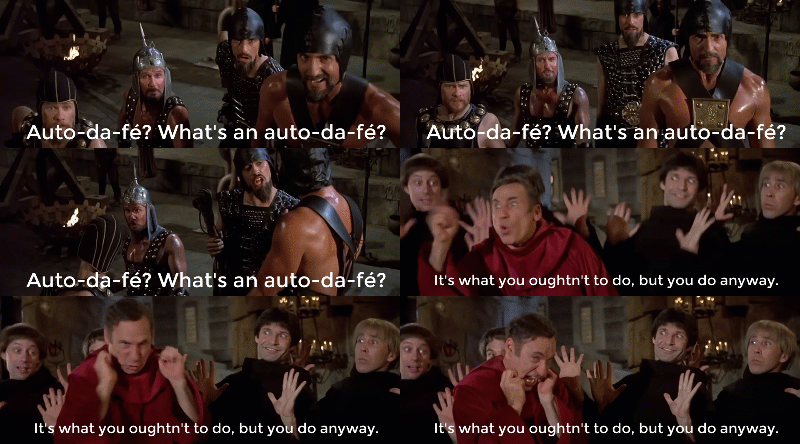
Today's term is pretty dark, but the movie History of the World: Part I makes light of it:

"Auto-da-fe? What's an auto-da-fe?
It's what you oughtn't to do but you do anyway."

(Source)

He's not wrong! An auto-da-fe is a burning at the stake, literally or figuratively: a violent act of persecution.

While we're on the topic of setting fire to each other, see if you can recall a word that means "to sacrifice by fire; to destroy by fire:" it's im___ate.

(To reveal any word with blanks, give it a click.)  

definition:

"Auto-da-fe" traces back through Portuguese to the Latin actus de fide, "an act of faith," and more specifically "a legal order of faith."

(If you're wondering why the "auto" in "auto-da-fe" means "act" instead of "self," I'm also wondering that! I couldn't find a satisfying answer, but I'm guessing that it just switched from "actus" to "auto" when it went through Portuguese or perhaps Spanish.)

Here's the basic background, and please keep in mind that I'm not a historian and that my goal here is provide a quick summary. We've used "auto-da-fe" in English since the late 1600s. It first meant "a public ceremony where people would commit themselves to the Catholic church," generally by force after having been suspected of not conforming to that religion. Because these ceremonies would sometimes be followed by a public punishment—sometimes a burning to death—the term "auto-da-fe" also grew to mean "the public burning to death of a person for the 'crime' of not conforming to the religion of the Catholic church."

By the 1700s, we were using "auto-da-fe" figuratively to mean "any act of burning, hurting, or just strongly criticizing someone or something, usually for having the 'wrong' beliefs or opinions."

grammatical bits:

Part of speech:

Noun, the countable kind: "In an episode of Firefly, River is accused of witchcraft and about to be burned at the stake, but Mal and Zoe arrive at the auto-da-fe just in time to save her."

Other forms: 

You might still see some writers use the special character over the "e:" "auto-da-fé." And some writers prefer to italicize the phrase to emphasize its foreignness: auto-da-fe.

The plural is rare, but if you need it, it's "autos-da-fé," pronounced "AT oze duh FAY." Hear it here.

how to use it:

Although you could pick a clearer and more common phrase like "burning at the stake" or "ritualistic burning," you might want to pick "auto-da-fe" if you're trying to sound very serious, formal, and historical.

These days, we use "auto-da-fe" to talk about current events in a loose, figurative way. You could say that people hold or conduct or order an auto-da-fe of their political opponents. Or you could say that people dodge or escape an auto-da-fe. Check out Maureen Dowd's startling example below of someone lighting their own auto-da-fe.

examples:

"The Democrats are counting on Trump to self-destruct. And certainly, he loves to light his own auto-da-fe and incriminate himself."   
  — Maureen Dowd, New York Times, 28 April 2028


"During World War I, the [Prohibition] amendment swept through the states and Congress like a purging auto-da-fe. Fighting in Europe’s 'war to end all wars,' young American soldiers were the saviors of civilization, and the country they called home should purify itself to be worthy of its new status as the leader of nations."   
  — Patt Morrison, Los Angeles Times, 6 December 2022

has this page helped you understand "auto-da-fe"?


Awesome, I'm glad it helped!

Thanks for letting me know!
If you have any questions about this term, please message me at Liesl@HiloTutor.com.


study it:

Explain the meaning of "auto-da-fe" without saying "burning at the stake" or "witch hunt."

try it out:

Some writers have made figurative use of "auto-da-fe" by referring to any fervent burning of materials, like letters or pictures or books, as an auto-da-fe—implying that the materials seem so horrid and so in need of being purged from the world that just chucking them in a dumpster wouldn't be enough. Only a ritualistic burning would do.

Let's see some examples:

1. From a 1794 journal: "I will soon lay upon the table my letters of ordination, of which I hope you will have the kindness to make an Auto da Fé." (Must have been some pretty regrettable letters.)

2. From a 1912 literary reference book: "Immediately after his death his mother... took possession of his [scientific] papers, and in an immense auto-da-fe destroyed in an hour the records of a lifetime of work." (Whyyyyy?)

Maybe Taylor Swift had an auto-da-fe in mind when she wrote this in a 2006 song:
   "So watch me strike a match on all my wasted time.
    As far as I'm concerned, you're just another picture to burn."

With these examples in mind, have you ever felt such intense disgust toward any books, papers, or pictures that you would consider lighting them up in a figurative auto-da-fe? Why or why not?


before you review, play:

Try to spend 20 seconds or more on the game below. Don’t skip straight to the review—first, let your working memory empty out.

Our game this month is "Literally That."

I’ll give you a gif and several synonyms that describe it, and you figure out which of these synonyms is most literally illustrated in the gif. You can check out some examples here.

Try this one today:

(Source)

A. bloviating
B. fanfaronade
C. rodomontade

To see the answer, scroll all the way down. 

review this word:

1. There's probably not an exact opposite of AUTO-DA-FE, but a near opposite could be

A. EVANGELISM: the act of spreading one's religion.
B. OBEDIENCE: the act of complying with rules or orders.
C. CANONIZATION: the act of declaring someone a saint.

2. "Auto Da Fe" is the name of a rock climbing route in Australia, suggesting _____.

A. a gently sloping climb
B. a punishingly steep climb
C. a salty, windy climb by the ocean


Answers to the review questions:
1. C
2. B

From the game:

I was thinking of "rodomontade": bragging about moving mountains. Not exactly the same as throwing a football over them, but pretty close! Bloviating is literally about blowing hot air, and fanfaronade, about tooting on a trumpet.


a final word:


I hope you're enjoying Make Your Point. It's made with love.

I'm Liesl Johnson, a reading and writing tutor on a mission to explore, illuminate, and celebrate words.


From my blog:
On vocabulary...
      36 ways to study words.
      Why we forget words, & how to remember them.
      How to use sophisticated words without being awkward.
On writing...
      How to improve any sentence.
      How to motivate our kids to write.
      How to stop procrastinating and start writing.
      How to bulk up your writing when you have to meet a word count.

From my heart: a profound thanks to the generous patrons, donors, and sponsors that make it possible for me to write these emails. If you'd like to be a patron or a donor, please click here. If you'd like to be a sponsor and include your ad in an issue, please contact me at Liesl@HiloTutor.com.


A disclaimer:
When I write definitions, I use plain language and stick to the words' common, useful applications. If you're interested in authoritative and multiple definitions of words, I encourage you to check a dictionary. Also, because I'm American, I stick to American English when I share words' meanings, usage, and pronunciations; these elements sometimes vary across world Englishes.

Subscribe to "Make Your Point" for a daily vocabulary boost.


© Copyright 2026 | All rights reserved.